

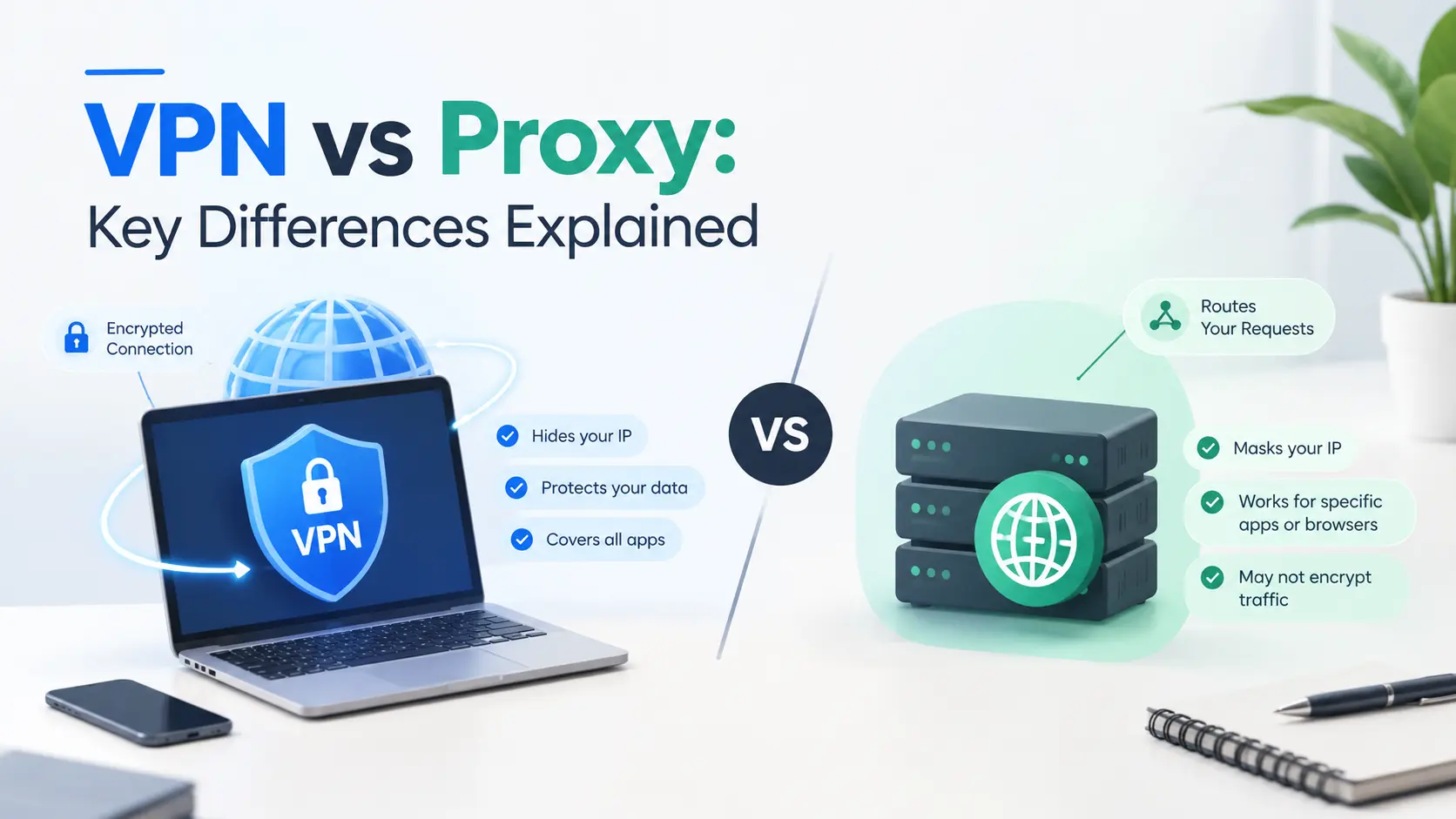
Online privacy and internet security have become increasingly important as people spend more time browsing websites, using public Wi-Fi, and accessing online services. Two common tools that can change how your internet traffic appears to websites are VPNs and proxy servers. Although both can hide your original IP address, they work differently and offer different levels of protection.
Understanding the difference between a VPN and a proxy can help you choose the right option for your browsing habits, security needs, and budget.
What Is a VPN?
A Virtual Private Network (VPN) creates an encrypted connection between your device and a VPN server. Your internet traffic travels through this connection before reaching its destination.
When you connect to a VPN, websites generally see the IP address of the VPN server instead of your original public IP address. Encryption also helps protect your traffic from being read by people monitoring the network, particularly on unsecured public Wi-Fi.
VPNs are commonly used for improving online privacy, securing internet connections, and connecting to networks remotely.
Key benefits of a VPN include:
- Encrypted traffic: Helps protect data while it travels between your device and the VPN server.
- IP address masking: Websites generally see the VPN server’s IP address.
- Public Wi-Fi protection: Reduces the risk of others on the same network intercepting unencrypted traffic.
- Broad device coverage: Many VPN apps can protect traffic from multiple applications on your device.
- Remote access: Businesses can use VPNs to let employees securely access internal systems.
However, a VPN does not make you completely anonymous. Your VPN provider may be able to observe certain connection information, and websites can still track you through cookies, account logins, and browser fingerprinting.
What Is a Proxy Server?
A proxy server acts as an intermediary between your device and a destination server. Instead of connecting directly to a website, your request passes through the proxy, which forwards it to the destination.
The website generally sees the proxy’s IP address rather than your original public IP address.
Proxies are often used to route browser traffic, access region-specific web content where permitted, manage network requests, and support web testing or data collection.
Key benefits of a proxy include:
- IP address masking: Can hide your original IP address from the destination website.
- Application-specific routing: Can route traffic from a particular browser or application.
- Content filtering: Organizations can use proxies to control access to certain websites.
- Caching: Some proxies store frequently requested content to improve performance.
- Flexible configuration: Proxies can be configured for specific tasks without routing all device traffic.
One important limitation is that many proxies do not encrypt your traffic. If you use an unencrypted proxy over an insecure connection, your data may remain exposed to network monitoring. HTTPS still protects the connection between your browser and an HTTPS website, but it does not automatically make every part of the proxy connection private.
VPN vs Proxy: Key Differences
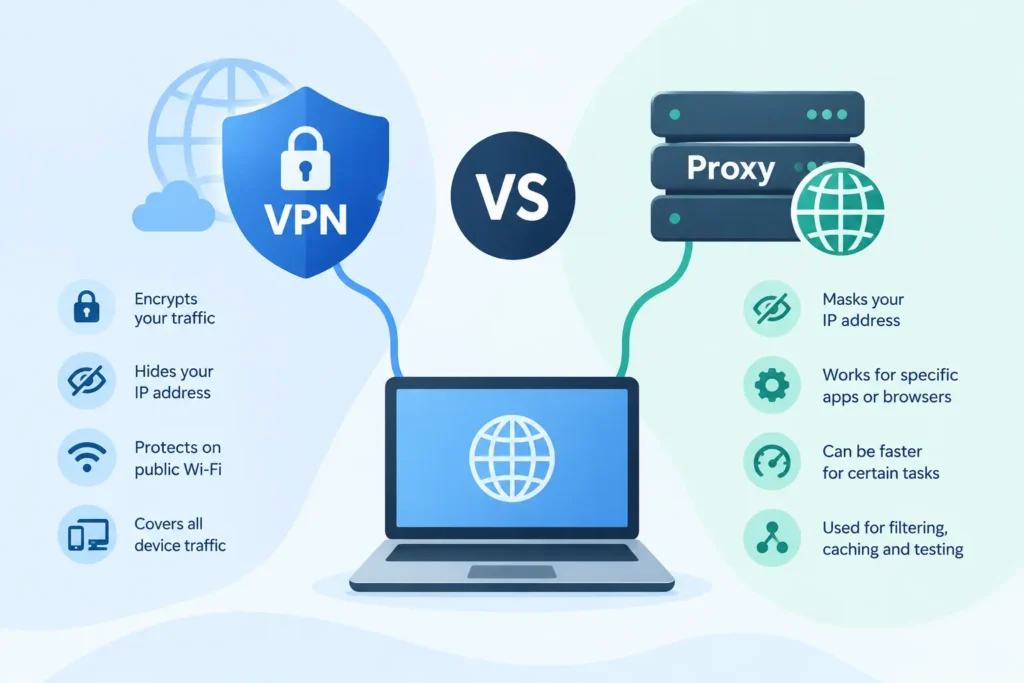
Although VPNs and proxies can both mask your IP address, their main differences involve encryption, coverage, and privacy.
| Feature | VPN | Proxy |
|---|---|---|
| Main purpose | Privacy and secure network connections | Routing requests through an intermediary |
| Encryption | Typically encrypts traffic between your device and the VPN server | Depends on the proxy type and configuration |
| IP address masking | Yes, for traffic routed through the VPN | Yes, for requests routed through the proxy |
| Traffic coverage | Often covers most device traffic | Often limited to a specific app or connection |
| Speed | Can introduce some overhead due to encryption and routing | May be faster for some tasks, but depends on the service |
| Setup | Usually requires an app or system configuration | Often configured in a browser, app, or network |
| Best use cases | Public Wi-Fi security, privacy, remote access | Filtering, testing, and routing specific requests |
Neither option guarantees complete anonymity or prevents every form of tracking.
Which Is More Secure: VPN or Proxy?
For general online privacy and security, a reputable VPN is usually the better choice because it encrypts traffic between your device and the VPN server.
This can be especially useful when connecting through public Wi-Fi at airports, hotels, or coffee shops.
A proxy may be sufficient when you only need to route specific browser requests through another server. However, a basic proxy should not be treated as a substitute for a VPN when encryption is important.
It is also worth remembering that HTTPS protects data exchanged with secure websites independently of whether you use a VPN or proxy. A VPN adds another layer of protection between your device and the VPN server, but it does not make malicious websites safe or prevent phishing attacks.
When Should You Use a VPN?
A VPN may be the right choice if you:
- Frequently use public Wi-Fi networks.
- Want to encrypt traffic across multiple applications.
- Need a secure connection to a workplace or private network.
- Want to reduce the exposure of your public IP address to websites.
- Prefer a single service to manage privacy across your device.
Choose a provider with transparent privacy policies, strong encryption, reliable security practices, and clearly explained data-retention policies.
When Should You Use a Proxy?
A proxy may be more appropriate if you:
- Need to route traffic from one browser or application.
- Are testing how a website behaves from different network locations.
- Manage organizational web filtering or caching.
- Need a lightweight solution for a specific networking task.
Be cautious with free proxy services, particularly those that require installing unknown software or handling sensitive information. An untrustworthy provider could log your activity or expose your data.
Final Verdict: VPN vs Proxy
The choice between a VPN and a proxy depends on what you need. A VPN is generally more suitable for everyday privacy and security because it typically encrypts traffic and can cover multiple applications. A proxy is useful for specific routing tasks, web testing, and network management, but its security depends on the type of proxy and how it is configured.
For most everyday users, a reputable VPN is the more practical option when privacy and secure connections are the main priorities. If you only need to route particular requests through another server, a proxy may be enough.
Before choosing either service, consider its privacy policy, security features, performance, and reputation. The best solution is the one that meets your needs without creating unnecessary security risks.