


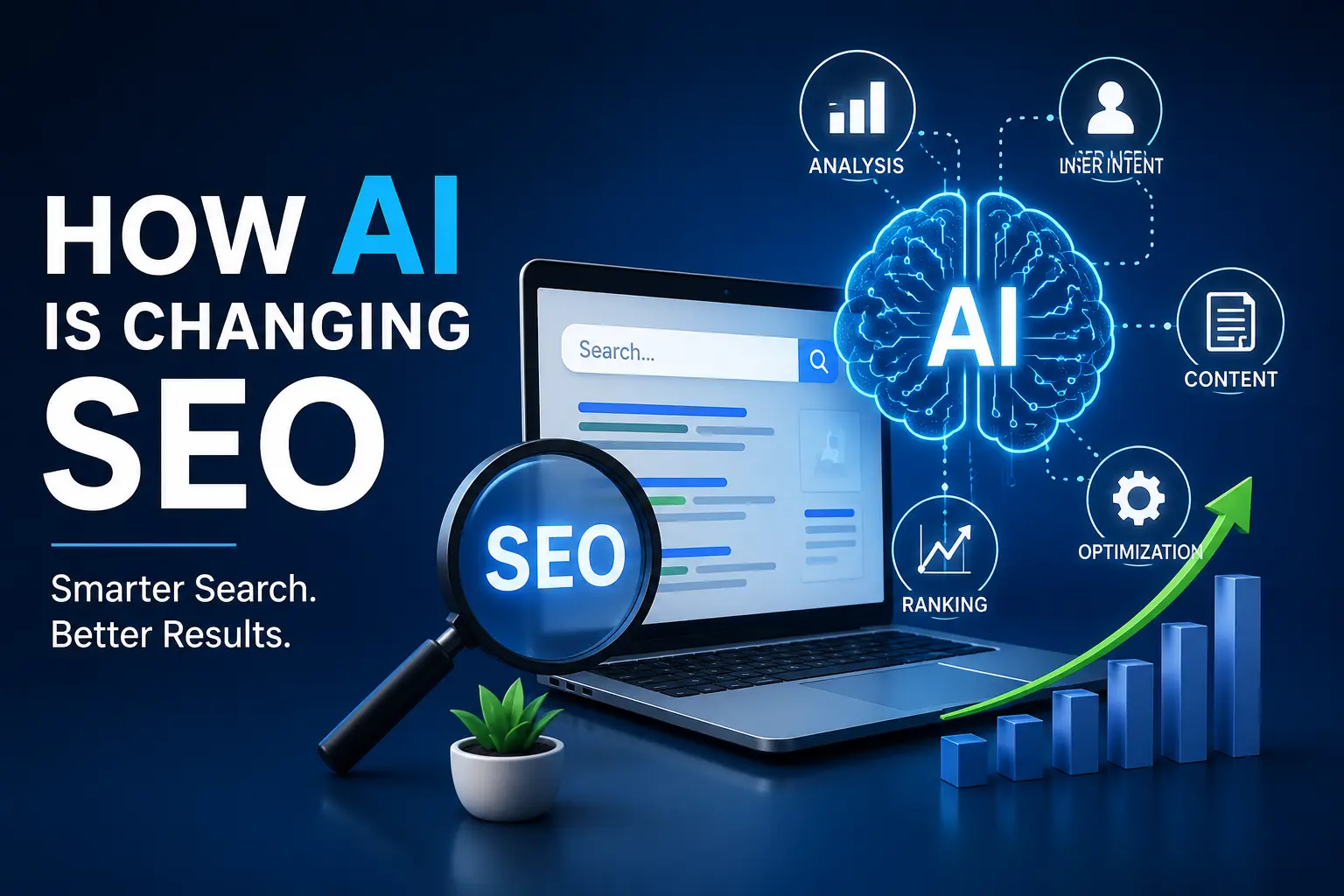
How AI Is Changing Search Engine Optimization
SEO has always been a technology based field, but with AI, it has seen some of its biggest and greatest transformations. To make sure that businesses are visible on the web, search engines are getting smarter and faster users are becoming more demanding and also want faster, better results.
Today, beyond the keywords, the quality of the content, their relevance and the user experience are considered. By comprehending the impact of AI in search, businesses can produce superior search-optimized material and enhance their online visibility.
AI’s Rise and Impact in SEO.
AI can help search engines know the intent behind search terms, rather than just matching the keywords. AI algorithms can process user interactions, search queries, the quality of the content, and relevance to provide more meaningful search results.
For web owners, it has become more vital to create useful information that solves the queries of users than to repeat the same keyword repeatedly.
AI Enhances Search Intent Understanding.
One notable advancement brought by AI is its capability to interpret search intent. AI enables search engines to understand what users are searching for.
For this reason, companies should give priority to creating content that meets user’s needs instead of only focussing on the keywords.
With the onset of the internet age, of course, improved content quality is now more significant than ever.
AI Websites to Create Valuable Content
These days, search engines are considering the readability, relevancy, originality, and content quality of a website that can help users find a solution to their query.
Articles that offer useful, helpful information and trusted expertise in the simplest of terms are more likely to rank high on search results.

AI Assists in Developing Advanced SEO Strategies
AI tools are now instrumental for businesses in discovering keyword opportunities, providing competitive analysis, crafting content ideas, optimizing headings, and tracking website performance.
They assist marketers to leverage data to make decisions sooner, and in a more efficient manner. AI is not a substitute for human expertise and creativity, however, it is best employed in conjunction with these qualities.
Voice Search is Impacting SEO
As with many other areas of the internet, more people are turning to natural language for their Web searches with the rise in popularity of voice assistants. Compared to conventional text search technologies, voice search queries are longer and more natural.
In response, businesses need to develop point of purchase materials which respond to typical questions in a natural way. Simplifying word by word explanations with headings or casual style pronunciation may be helpful for voice.
Personalization Is Changing Search Results
The AI feature enables search engines to tailor content to the user’s preferences and past searches, which is something they haven’t been able to do before. Consequently, various users might have different results from the same query.
The emphasis should be placed on producing material beneficial to their intended audience, taking into account regional search engines, client demands and pertinent matters that will attract the right audience.
The Future of AI and SEO
In a world where AI is evolving, SEO is becoming even more usful on creating better experiences than it presently is. Companies that put in the effort to provide high-quality content, enhance their website with technical features, and ensure that their users are happy will be equipped for long-term success.
AI isn’t a threat to marketers, it’s a tool that can help them in conducting better research, outlining their content strategy, and optimizing it, while keeping content original and authentic.
Conclusion
AI has been changing the use of SEO by simplifying the way search engines work and focusing more on user intent, content quality, and user experience.
Those that adapt to these changes in their SEO approaches will be having more secure improved rankings in the search engines and establish sustained visibility.